
Thanks to Russian Sanctions, Bitcoin Has Decoupled From the Stock Market
The consequences of the financial isolation of Russia are perhaps being underestimated by markets.
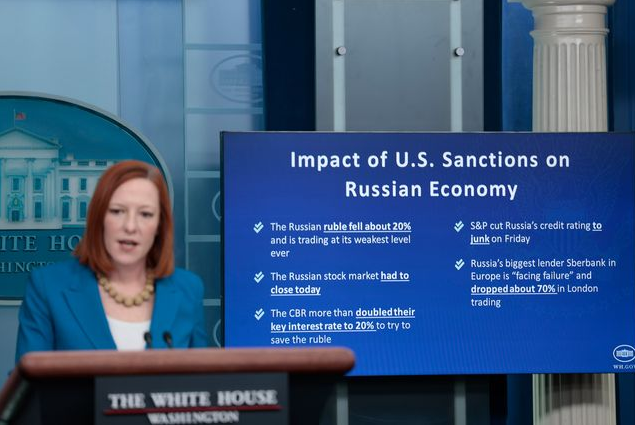
Sanctions imposed on Russia have been designed to cripple its economy and financial systems—and they have worked as intended. Russia’s central bank closed the country’s stock market and more than doubled its key interest rate to 20% to protect the tumbling ruble, which fell more than 20%.
Western companies, including BP, Shell, and many more, have joined countries in turning their backs on Russia in light of its invasion of Ukraine.
It isn’t just sanctions on Russia. Russian President Vladimir Putin has banned residents from sending money abroad. Corporate foreign debt of banks and nonfinancial companies stood at $394 billion in the second quarter of 2021, ING reported, citing Bank of Russia data.
MSCI, the equity index compiler, is also considering removing Russia from many of its indexes and could potentially reclassify it as a stand-alone market from an emerging market.
While stock markets have actually seen only minor hiccups, Bitcoin has climbed more than 12% in the past 24 hours to above $43,000. With financial sanctions prohibiting transactions both to and from Russia, cryptocurrencies could come into their own.
“To unilaterally decide to ban people’s access to their crypto would fly in the face of the reason why crypto exists,” Binance said, succinctly explaining why exchanges may not impose sanctions of their own.
The isolation of Russia may finally have decoupled Bitcoin from the falling stock market.